I woke at 05.45 and 2 pilgrims were packing to leave. I looked at the weather forecast and it said rain would start at 09.00 so I thought go now and get three hours without rain. So I did and departed the Alberge at 06.06.
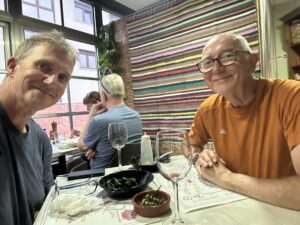
(Last night I ate with Laurie we went to a place called Pasta, which was run by an Irish couple well she was Irish, it had about 10 tables and was very busy but it was perfect. Padron Peppers and a chicken, mushroom, and spinch, very good food )
At 06.06 it was very dark! Sunrise is not due until 08.50. So this would mean twilight about 08.10. I used my head touch but you really have to concentrate. The first hour was ok but at every junction I had to look for yellow arrows to make sure I didn’t leave the Camino.
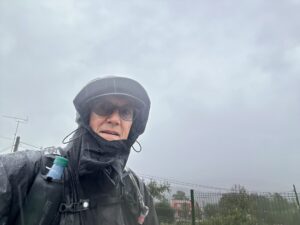
I saw about two pilgrims total for the first 2 hours. It was showery on and off so it was hood on hood off for most of it. I didn’t really enjoy walking in the dark and my mood actually dropped for the first time, but only a little.
At 7.50 I stopped for coffee, I actually had two cups, tgen headed back out. I was using a headtorch when I stopped but I didn’t need just 20 minutes later
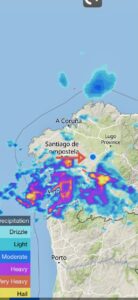
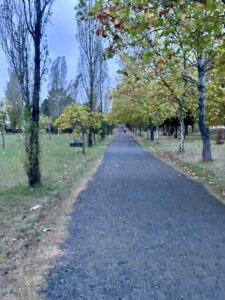
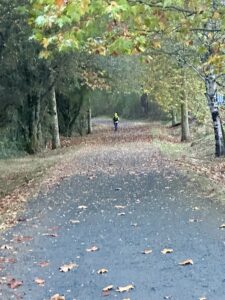

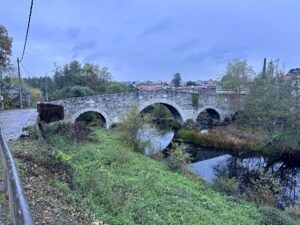
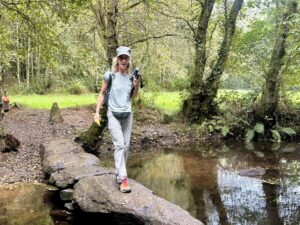
At about 15km I met up again with Ellen and we chatted for about 2 hrs.

Stats
Today
Distance: 29.45km
Elevation: 605m
Duration: 4h57
Totals
Distance: 252.90(727.33) Km
Elevation: 4,516(12,534) m
Duration: 52h34(153h53)
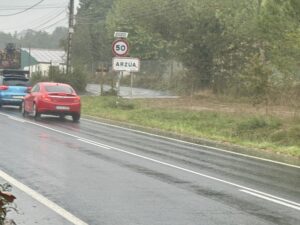
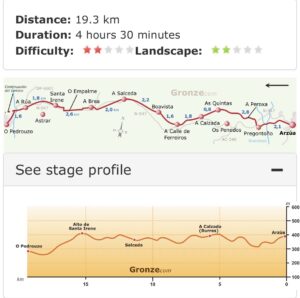
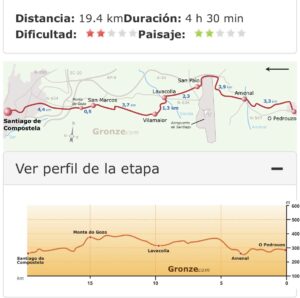
Tomorrow I do 1 1/2 stages (Stage 32:Arzúa – O Pedrouzo-19.3km and Stage 33: O Pedrouzo – Lavacolla-9.5km) a total of 28.8km.
A comfortable stage with few elevation changes; we advance along long forest tracks, crossing woodlands and meadows. As in the previous stage, we follow the main road of the N-547 then from O Pedrouzo, the stage presents no significant gradients; the climb to Monte do Gozo is moderately steep.
Footnote:
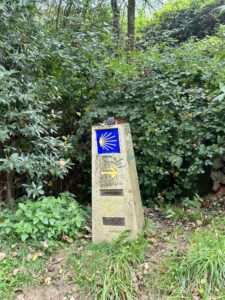
There is discussion among pilgrims as to why the km markers go to three decimal places. I did some research on AIif tge contractor was paid per digit. The answer:
The Xunta de Galicia commissioned new granite markers around 2010 as part of a modernisation project. The Galician cartographic institute (Instituto Geográfico Nacional de Galicia) provided digital distance data in metres, automatically converted into kilometres with three decimal places. The contractor simply engraved whatever numbers the database produced — without rounding or cleaning them up — because that’s what was in the official tender documents.
So while they weren’t paid per digit, they were paid to reproduce the data exactly as supplied. Nobody wanted to take responsibility for “changing” the official numbers, so the absurd precision stayed.
The result: the Camino is now sprinkled with mathematically meaningless but bureaucratically perfect numbers like 23.742 km to Santiago.
It’s a very Spanish solution — or perhaps more accurately, a very Galician one.
I’m not convinced 😉